Sunday, December 27, 2009

PM sees reforms benefiting poor

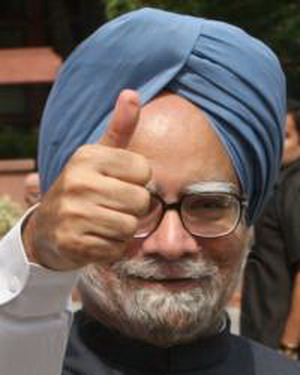
Manmohan Singh
Manmohan Singh : PM sees reforms benefiting poor

Bhubaneswar, Dec. 27: Prime Minister Manmohan Singh today said the economic reforms initiated by him almost two decades ago had reduced the number of poor, though much more was still needed to be done.

“There is no evidence that the new economic policies have had an adverse effect on the poor,” Singh said at the annual conference of the Indian Economic Association here today.

“The percentage of population below the poverty line has certainly not increased. In fact, it has continued to decline after the economic reforms, at least at the same rate as it did before,” he said.

Singh, however, admitted that the decline should have been faster. Reforms were introduced during Singh’s tenure as finance minister in Narasimha Rao’s Congress government in 1991-96.

“There is no doubt in my view that poverty remains a major challenge. Our poor are still too poor and we need to do much more to improve their standards of living,” Singh said, highlighting the need for rapid economic growth to create job opportunities at a rate faster than the expansion of labour force.

According to the Prime Minister, greater attention should be paid to education, healthcare and rural development, particularly the needs of the Scheduled Castes, Scheduled Tribes and minorities, to achieve the objective of inclusive growth as charted out in the Eleventh Plan.

An efficient use of scarce natural resources such as land and water, increasing agricultural productivity and systematic efforts to help small industries in mobilising resources for growth were also necessary for a sustained expansion.

On the impact of reforms, Singh said an average growth rate of 8.5 per cent had been achieved between 2004-05 and 2009-10. The momentum was interrupted by the global economic crisis in 2008, and growth slowed to 6.7 per cent in 2008-09. However, the economy was likely to achieve growth at a little over 7 per cent in 2009-10. Besides, there was no balance of payments crisis since 1991.

On climate change, the Prime Minister said the problem could be resolved if all the countries reached a mutually satisfactory solution.

Prime Minister Manmohan SinghPM sees reforms benefiting poor
Prime Minister Manmohan Singh

Pointing out that sustainable development was intimately linked with energy efficiency and energy security, he said it also posed complex problems of global equity in burden sharing.

“Economists have much to contribute to our understanding of complexities involved and finding constructive solutions,” he said.

Orissa chief minister Naveen Patnaik said about 5 per cent of the country’s poor were in Orissa, while there was a large population (38.66 per cent) of Scheduled Castes and Scheduled Tribes.

He said the state government had been trying to improve its fiscal health and plan performance and create an investor-friendly environment. “Our efforts have yielded some very positive results with the state achieving an annual average growth rate of 9.15 per cent during the Tenth Plan.” (News Courtesy By Telegraphindia.com)
Readmore »

No further action until consensus: Manmohan assures Buddhadeb

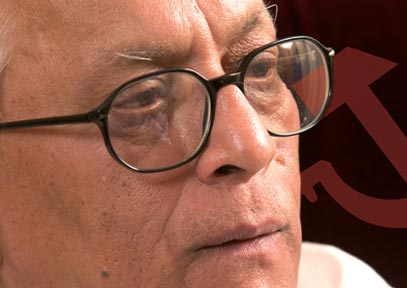
West Bengal Chief Minister Buddhadeb Bhattacharjee


No further action until consensus: Manmohan assures Buddhadeb

West Bengal Chief Minister Buddhadeb Bhattacharjee addressing the media in New Delhi on Sunday.

NEW DELHI: Prime Minister Manmohan Singh has assured West Bengal Chief Minister Buddhadeb Bhattacharjee that the Centre will not proceed on the Telangana issue until consensus is arrived at. Mr. Bhattacharjee told journalists here on Sunday that he called on Dr. Singh on Saturday seeking to know how the Centre intended solving the Telangana issue as it had a direct bearing on the hill areas and other parts of West Bengal.

It was learnt from the Prime Minister that the Centre was seriously trying to initiate a dialogue at the State and national levels.

Mr. Bhattacharjee pointed out that various parties had taken different stands and the parties in Andhra Pradesh were also divided on the Telangana issue.
Pandora’s box

He stressed his opposition to creation of smaller States, saying it was neither possible nor desirable in the present circumstances.

He warned that the setting up of a second States Reorganisation Commission would only open a Pandora’s box. “What for? The demand currently is for creating 28 States. If you set up the Commission, the number will only increase.”

The two leaders also discussed the issue of naxalites. Mr. Bhattacharjee said a national-level operation against them would start soon. The situation in Jharkhand was being assessed as a new government is to be formed there.

He said the naxal problem could not be solved through policing alone, and called upon Mamata Banerjee’s Trinamool Congress to attend meetings held by the district administration and participate in the process of restoring peace and harmony.

Mr. Bhattacharjee said the anti-naxal operations in West Bengal had yielded results with main roads coming under government control. “We are yet to enter the villages located in the forest. It is very difficult. They throw bombs and kill innocent people.”

Asked if he had raised the issue of Trinamool’s alleged links with naxalites with the Prime Minister, Mr. Bhattacharjee said: “I don’t need to do that. He knows everything.”

To another question, Mr. Bhattacharjee said his government was serious about arresting Maoist leader Kishanji, who was talking to hundreds of journalists every day and yet remained elusive. The government identified a mobile tower but locating him in that area was proving difficult.

The Chief Minister said he had read reports about the protest Kishanji lodged on the phone with Principal Environmental Secretary Madan Lal Meena against polluting mines. Mr. Bhattacharjee said he would talk to Mr. Meena.

The Prime Minister also assured the Chief Minister that he would look into the problems afflicting the Haldia Port, and at setting up industries at pitheads of mines and formulation of a separate jute policy to boost export.
New Governor

The State will have a new Governor by Republic Day to fill the vacancy caused by the expiry of tenure of Gopalkrishna Gandhi.

Dr. Singh conveyed the Centre’s intention to Mr. Bhattacharjee on Saturday.

Mr. Bhattacharjee declined to divulge specifics on the matter. He admitted that names were discussed. The appointment would be made before Republic Day.

He also refused to comment when asked if Union Minister Mamata Banerjee’s proposal of retired Justice Rajinder Sachar for the post was discussed with Dr. Singh. (News Courtesy by Hindu.com)

West Bengal Chief Minister Buddhadeb Bhattacharjee
Readmore »

Wednesday, December 2, 2009

RIL-NTPC gas price needs govt okay: Govt

RIL-NTPC gas price needs govt okay: Govt (News Courtesy By : EconomicTimes)

NEW DELHI: The government has said that the price at which Reliance Industries supplies natural gas to some power plants of state-owned utility
NTPC would have to be approved by it. That price, $2.34 per million British Thermal units (mmBtu), was arrived at through a competitive bidding in 2003. “The price offered by the contractor (RIL) to NTPC will require scrutiny and approval of the government under the PSC,” said the ministry of petroleum and natural gas in its affidavit.

The affidavit did not say if the price of $2.34 per mmBtu would eventually be approved. “The central government will take an appropriate decision in the case of NTPC as and when a need arises. Such a decision based on public interest, if in favour of NTPC, cannot be termed as discriminatory or arbitrary,” was all that the affidavit had to say.

The document clearly contradicted NTPC’s stand. The chairman and managing director of the PSU, RS Sharma, had written a letter on August 28, 2009, to power secretary H Brahma saying, “NTPC reiterates its position that RIL did not mention in its bid that price of gas shall be subject to approval of the government.” Both NTPC and RIL are fighting a legal battle in the Bombay High Court on whether the two companies had signed a final contract following the bidding.

In 2007, the government fixed a price of $4.20 per mmBtu for sale of natural gas from the Krishna-Godavari basin to some power and fertiliser companies.

The price of $2.34 per mmBtu and the question of government approval is at the heart of the epic legal battle between Anil Ambani’s Reliance Natural Resources (RNRL) and Mukesh Ambani’s Reliance Industries (RIL). The famous memorandum of understanding signed between the estranged Ambani brothers provides for supply of gas at the price no greater than price payable to NTPC. RNRL has argued that RIL is free to sell gas to customers without the government approval. RIL contests this, saying the price needs the sanction of the Union government.

The government in its affidavit seemed to support the RIL position. “The rights and obligations of NTPC and RIL can not be regarded as similar in status to the private arrangement as in the case of RIL and RNRL, as NTPC is not only a PSU but the process involved for price determination in the case of NTPC gas was by international competitive bidding.”

It further said: “the central government has on the one hand, left NTPC to establish its rights in the pending suit in the Bomaby High Court, on the other hand, has not foreclosed any options available under the PSC. However, such a decision would be taken by the competent authority having regard to the character of the PSU and other relevant circumstances having a bearing on the public interest.”

Besides the NPTC affidavit, Mukul Rohtagi, another legal eagle representing RNRL continued his arguments on Wednesday. Mr Rohtagi claimed a price of $4.20 per mmBtu would allow ‘profiteering’ by RIL, claims echoing those made by Anil Ambani. He also claimed that sale at $2.34 per mmBtu would not a losing proposition for RIL.
Readmore »

Deal in Copenhagen likely, India under more pressure: Pachauri

Deal in Copenhagen likely, India under more pressure: Pachauri (News Courtesy By Hindustan Times)

Thanks to recent announcements by the US and China, there may be a deal at this month's Copenhagen climate summit, Intergovernmental Panel on Climate Change (IPCC) chief RK Pachauri said on Tuesday. This would put more pressure on India, which needed to quantify the steps it was taking to reduce global warming, he added.

"India is at the crossroads" on this issue, Pachauri said at a press conference in New Delhi, urging Prime Minister Manmohan Singh to attend the final two days of the Dec 7-18 climate summit in Copenhagen. "This will be important, as it will signify that India is a deal maker and not a deal breaker," he said.

Pachauri predicted that US President Barack Obama's announcement that his country would cut greenhouse gas (GHG) emissions by 17 per cent by 2020, compared to 2005, and China's announcement that it would reduce the GHG-intensity of its economy by 40-45 per cent by 2020, compared to 2005, would put more pressure on India to come up with similar quantitative commitments.

"The Copenhagen summit also gives us an opportunity to look at India's long-term future," added the head of the IPCC -- the group of over 2,500 scientists worldwide that brings out the benchmark assessment reports on climate change.

Making a strong pitch for the country to shift towards renewable energy sources from fossil fuels, Pachauri said "India must bargain at Copenhagen for large-scale resources to finance its solar mission".

He laid down three criteria for success at Copenhagen -- first, a collective emission reduction target by industrialised countries by 2020, which he said would be "good if it was 20 per cent"; second, financial assistance to developing countries to cope with climate change effects; and third, transfer of green technologies cheap, perhaps through a technology fund.

"If this happens there will be enormous pressure on India to make commitments," Pachauri predicted. "India should then lay its National Action Plan on Climate Change (NAPCC) on the table. The cabinet has already cleared the solar mission (one of the eight missions under NAPCC), that should be a part of it."

"The NAPCC can be a binding commitment on the part of India as a back-up if other commitments (from industrialised countries) fall in place," he added. He agreed that other NAPCC mission plans had not been firmed up yet, but said if this was done, the reduction in India's GHG intensity could be worked out as an offshoot of NAPCC. "It's simple arithmetic."

While saying "no country will reveal its cards upfront" at the start of the Copenhagen summit, Pachauri repeatedly pointed out that moving towards a greener economy was good for India in the long run.

GHG emissions -- mainly carbon dioxide -- is causing climate change, which is already reducing farm output, making droughts, floods and storms more frequent and more severe, and raising the seal level.
Readmore »

Thursday, November 26, 2009

Live Channels - Live iNews Tv Channel

Watch 24 Hours Live Programmes and News through online at Channel iNews


Readmore »

Monday, November 23, 2009

Shilpa's big fat Indian wedding - Entertainment News

November 23, 2009 - Shilpa's big fat Indian wedding :
"Itna thak gaya hun dance kar ke ki lag raha hai jaise kisi ne mujhe maara hai pakad ke" — these were Raj Kundra’s first words to a friend the morning after he brought home his bride, Mrs Shilpa Raj Kundra.

The wedding that was solemnised on Sunday evening at Bawa Villa in Khandala was a fairytale moment — the décor was done up completely in red, with velvet, satin, roses and candles decking the venue, and the mandap was designed like a south Indian temple.
Film producer Vashu Bhagnani and son Jackky were the only guests from the entertainment industry. Actors Rohit and Ronit Roy were also present, as they had organised the security for the event. The dinner was a mix of South Indian and Punjabi dishes.

Punjabiyan di shaan
The baarat came in true Punjabi style, with a maroon sherwani-clad Raj riding on a silver chariot. The ghodi kept making too many stoppages, which made Raj joke to his friends that “bahut nakhre waali ghodi hai” (the horse is very naughty).

Dressed in a red and gold sari, Shilpa choked back tears as the couple completed the last phera. Afterwards, the family headed to Shilpa’s house for the bidaii ceremony.

Shilpa’s friend Kiran Bawa says, “The bidaii ceremony was very short since Raj was very tired. Shilpa’s mother performed the traditional milk ceremony and the couple then headed to Raj’s house in Juhu.” Yesterday, the couple were with family and friends playing post-wedding couples’ games.

All ain’t welcome
Though the wedding was a close-knit affair, not everyone related to Shilpa were present at the do. Sources say that Shilpa’s maternal grandmother, Vijayakka, was not invited for the wedding because of family differences.

Shamita’s Rs 5-lakh demand

Shilpa’s sister, actress Shamita Shetty, demanded Rs 5 lakh of brother-in-law Raj Kundra for returning his shoes at the wedding. But Shamita had to settle with Rs 4 lakh less, as her jijaji negotiated well and brought the price down to Rs 1 lakh. Earlier, the Kundras had been told that Shamita was going to ask for Rs 51 lakh, so they were surprised by her demand, said a source.

Tonight’s plans

Tonight, the reception is being held at Grand Hyatt, Mumbai, where the lavish menu will include Italian, Mughlai and Indian cuisines. Punjabi pop band RDB will perform in front of 400 guests. Shilpa will wear a champagne-gold sari decked with 8,000 crystals. Raj will sport a black sherwani.
News Courtesy By Hindustantimes
Readmore »

Friday, November 20, 2009

World News - World - News World - News

Readmore »

Health News - Health News - Health News

Readmore »

Thursday, September 17, 2009

Top Stories - In The Month Of September 2009 - Onlne News Peper

Readmore »

Thursday, September 10, 2009

Business News In The Month Of September 2009 - Online News Paper 24

Readmore »