Friday, February 5, 2010

Cong leadership keeps arm length from Pak talks

NEW DELHI: The government may have decided that it was time it went back to the negotiating table with Pakistan but Congress leadership seems to be keeping a safe distance of the exercise. The Congress Working Committee, which met here on Friday, refrained from discussing the initiative which is seen as the first step towards resumption of composite dialogue stalled in the wake of 26/11 attack on Mumbai.

Always a politically fraught issue, ties with Pakistan have become even more sensitive because of Islamabad's reluctance to crack down on jehadi groups targeting India. Yet, sources said the issue has not been discussed so far even once at the Core Group, the highest decision-making body of the party.

That would make the move for foreign secretary-talks seem purely a government business.

The party would like it that way because the strategic aloofness can firewall it against the adverse fallout of any terror attack -- a real possibility, according to Indian as well as international intelligence agencies -- when the government is talking peace with Pakistan.

That the party leadership will prefer caution to bold diplomatic manoeuvres with Pakistan is a known secret. Sources stress that for the restoration of normalcy in ties to happen, Pakistan ought to sincerely try to bring the 26/11 masterminds to book.

PMO, however, sees profit in re-engagement, and hopes that the dialogue, besides undercutting the perception of India being unreasonable, can be used to nudge Pakistan to act against terror groups.

The gap between the two sides was evident when the party washed its hands off the ill-fated Sharm el-Sheikh joint statement. The fiasco and the bedlam that it caused back home has enhanced the premium on prudence.

That is why the party is expected to keep an eye on happenings even as it stays aloof. As diplomats from the two countries prepare to get down to hammer out the agenda for the foreign secretary-level talks, the leadership's assessment will determine the length to which the government can go to meet Pakistan's insistence on having a full-scale composite dialogue.
Readmore »

India face Laxman injury concern for South Africa Test

First Test: India v South Africa
Venue: Vidarbha Cricket Association Ground, Nagpur Date: 6-10 February Start time: 0400 GMT
India could be without batsman VVS Laxman for the first Test match against South Africa in Nagpur on Saturday.
The hosts are without the experience of Rahul Dravid and Yuvraj Singh because of injuries, while Laxman has yet to recover from a finger problem.

Subramaniam Badrinath looks poised to start alongside Murali Vijay for the world's number one ranked side.

South Africa, with interim coach Corrie van Zyl at the helm, look set to name Paul Harris as their frontline spinner.

Harris was wicketless after 12 overs for 71 runs against the Indian Board President's XI in midweek, but captain Graeme Smith said the left-armer remains his team's number one spinner.

"Where we have turned in the world, they have written off our spin bowlers," Smith told reporters.


"Paul is the man, it will take a lot for us to change that."

India's main concern will be coping without Dravid, who fractured a cheekbone after being hit by a short delivery during the 10-wicket win in the second Test over Bangladesh last month.

The absence of the 37-year-old, who surpassed Allan Border to move into fourth in the all-time leading Test run scorers' list in November last year, will give Tamil Nadu duo Vijay and Bradrinath an opportunity to impress.

"We will miss Rahul but somebody has to step up and do the work for the team," said India captain Mahendra Singh Dhoni, who stated the team were waiting on a prognosis of Laxman's injury before making a selection decision.

"I'm expecting some of the youngsters will get an opportunity to prove themselves and make runs for the side."

South Africa were ousted from their place at the top of International Cricket Council's world Test rankings in December following their innings and 98 run defeat by England in Durban.

That loss allowed Dhoni's side, fresh from a 2-0 series victory over Sri Lanka in December, to overtake South Africa and claim top spot for the first time since the rankings were devised.

However, the hosts will drop to second should the tourists win the series 1-0 or better, while a draw would consolidate India's position at the top of the standings.

"We came very close to beating them in 2008 (the series was drawn 1-1), when we won in England and Australia. We really wanted to win here," added Smith.

"It's a goal for us, it's an awesome challenge to win here, not many teams have done that."

South Africa arrived in India with Van Zyl as temporary coach for the two-Test, three one-day international tour following Mickey Arthur's resignation at the end of last month.
Readmore »

Yusuf fights back for West

South Zone's grip over the Duleep Trophy final loosened somewhat as the Pathan brothers - Yusuf and Irfan - led West's challenge in a match that has swung one way and the other. The fall of Irfan's wicket late on the fourth day meant that South would fancy their chances of picking up the four wickets and sealing victory at some point on the final day.

When the penultimate day began West were 50 for no loss chasing an unlikely 536 for victory. Nuggety left-handed opener Chirag Pathak, whose style of play is similar to his Saurashtra statemate and Ranji stalwart Sitanshu Kotak, set the stage with an important century at the top of the order.

Rarely pleasing on the eye, batting with a bottom-hand dominated grip, Pathak was the constant in vital partnerships of 117 for the first wicket with Harshad Khadiwale and 107 with for the second wicket with skipper Wasim Jaffer. Pathak (130) was eventually dismissed by mediumpacer Alfred Absolem when an attempted drive to a ball outside the off resulted in a thick edge back onto the stumps.

South were made to work hard for their wickets, an no one bowler dominated. Instead, Dinesh Karthik had to constantly rotate the bowlers, giving some part-timers a go.

Jaffer (66) made an error of judgment, shouldering arms to a delivery from C Ganapathy that came back in just enough to win the lbw shout. One wicket brought another as Bhavin Thaker opened the face of the bat in an attempt to steer the ball to third man and feathered an edge to the keeper.

South's hopes of tying up the loose ends quickly were dashed by Irfan and Yusuf, whose fluent batting transferred the pressure back into the bowling side.

The left-and-right combination changed the complexion of play, scoring at a fast clip. They added 84 for the sixth wicket, pushing the score to 378 before Irfan fell. It was Absolem once more who broke through, slanting a ball back in to the left-hander, enticing an edge onto the stumps. Irfan's 42 had come off 47 balls and included as many as 8 fours.

The worry for South is that Yusuf (84 not out, 71 balls, 7 fours, 5 sixes) is still at the crease. His belligerent approach has meant that the 157 needed for victory on the final day could be achieved in a tearing hurry.

Free entry for fans

Hyderabad's fans were denied entry on the first two days of the Duleep final as the home association felt large numbers could pose a security threat. In January crowds had disrupted a Twenty20 match and the Hyderabad Cricket Association did not want to take any chances.

However, they have had a change of heart, and fans are now being allowed to watch the match, free of charge, for the remainder of the match. (News Courtesy by Hindustan టైమ్స్)
Readmore »

Ex-MLA could face minimum 3 yrs in jail for giving shelter to IM terrorist

NEW DELHI: Indian Mujahideen terrorist Shahzad Alam's startling disclosure that he was sheltered by a former Delhi MLA after fleeing from the Batla House encounter scene in September 2008 could make the ex-legislator face a minimum sentence of thre years under the Unlawful Activities Prevention Act (UAPA).

For the IM terrorist had allegedly told the Delhi police that he was provided shelter and financial help by a former Delhi MLA after he escaped from the Batla House shootout on September 19, 2008, an incident which still evokes sharp reaction from political parties.

After the repeal of POTA to keep its election promise, UPA-I was in 2004 forced to make amendments to UAPA, 1967, and bring in specific provisions to deal with the growing shadow of terrorism on the country.

Section 19 of the amended UAPA provides for a minimum punishment of three years, which could in serious cases be extended to life term, for those who harbour or help conceal a terrorist, even after knowing that the person harboured is a subversive element.

The only loophole in the section, which the ex-MLA can exploit, is that the person giving shelter to the terrorist must have the knowledge about the activity of the guest.

Section 19 says: "Whoever voluntarily harbours or conceals, or attempts to harbour or conceal any person knowing that such person is a terrorist shall be punishable with imprisonment for a term which shall not be less than three years but which may extend to imprisonment for life, and shall also be liable to fine."

The stricter anti-terror laws enacted by the US and UK shortly after the 9/11 attack that snuffed out the existence of twin towers also have similar provisions to deter persons from extending help to terrorists.

Section 803 of Uniting and Strengthening America by Providing Appropriate Tools Required to Intercept and Obstruct Terrorism (USA PATRIOT ACT) Act enacted a few weeks after 9/11 refers to a host of provisions in other laws against terrorism and says anyone who harbours a terrorist "shall be fined under this title or imprisoned for not more than 10 years, or both."
Readmore »

Navy for partnership in Indian Ocean region

Chief of Naval Staff Admiral Nirmal Verma on Friday said the Navy preferred to work together with other navies in the Indian Ocean region rather than assume leadership as envisaged by the U.S.

“We are talking about coming together on a constructive level… and [Indian Navy] not coming in as a headmaster,” Admiral Verma said on the sidelines of a seminar organised as part of the multi-lateral “Milan” exercise, in which 13 countries are participating here.

He was responding to a question on how the country visualised its role following the Pentagon’s latest assessment that the Indian Navy was acquiring the capability and could possibly assume a greater security role in the region.

Nine foreign ships and delegations from 12 countries including Australia, Brunei, Bangladesh, Indonesia, Malaysia, Myanmar, New Zealand, Philippines, Singapore, Sri Lanka, Thailand and Vietnam arrived here on Wednesday for the 7th edition of the exercise.

The officers and personnel first held operational interaction and took part in a table-top exercise on Thursday aimed at enabling all participating ships to undertake joint planning towards building mutual confidence and improving inter-operability in dealing with problems like piracy, arms and drug running and illegal migration.

Admiral Verma said the theme of the seminar, “Navies in Humanitarian Assistance and Disaster Relief Operations,” gave the flavour of cooperation being envisaged by the different navies in the South and South East Asian region.

“Our coming together is not a security bloc but to cooperate to tackle man-made and natural disasters,” he said when asked whether the multi-lateral exercise could raise Beijing’s suspicion considering that some participating countries had maritime disputes with China.

On the “Malabar” exercises with the U.S., he said, it will remain bilateral. A few years ago, the exercise included navies of the U.S., Singapore, Australia and Japan, a move that did not go down well with China. On China’s capability and Indian preparations, Admiral Verma said the Navy’s plans were made taking into account the region and were not country-specific. He said India had the deterrence of conventional capability.

Admiral Verma said creating awareness among the fishing community to threats from the sea, a task undertaken as part of the coastal security plan, has started yielding results. Earlier in his inaugural address at the seminar ‘Andaman & Nicobar Islands,’ Lt. Gov. Bhopinder Singh underscored the need for speed in reaching out to disaster-affected countries. (by The హిందూ)
Readmore »

11 buried alive in building collapse

HYDERABAD: Ten labourers and a two-year-old boy were buried alive under the debris after a five-floor building under construction collapsed here on the bustling Narayanguda main road on Friday. Among the victims were four women.

Police, fire-service personnel and locals managed to rescue two labourers trapped under the debris using poclains and cranes, but the thousands of people thronging the area delayed rescue operations. Nearly 15 labourers were working on the fifth floor when the building caved in around 2.30 p.m.

Anxious parents of the students of Brilliant Grammar School, adjacent to the building, rushed to the spot. Fortunately, the school building developed only minor cracks on one side and no one was injured. Originally, it was a building of the erstwhile City Improvement Board Quarters. A builder had taken it for development and constructed five floors. “Having completed the slab work, walls were being constructed. It appears improper curing of walls weakened the structure leading to the building’s collapse,” Narayanguda Inspector G. Jogaiah said.

As the rubble fell on the road between the collapsed building and the abutting fly-over, manoeuvring of cranes and earthmovers became difficult. It took more than two hours to clear the huge concrete block that fell on top of the debris under which most of the labourers were trapped.

Home Minister Sabitha Indra Reddy instructed the police to arrest the builder immediately after inspecting the spot. Three GHMC officials were also suspended. (From హిందూ)
Readmore »

Shiv Sena threat casts shadow over 'My Name is Khan'

MUMBAI: Bollywood is jittery over the fate of "My Name Is Khan", one of its biggest films of the year, with lead actor Shah Rukh Khan facing the
ire of the Shiv Sena.

The hardline Hindu group has threatened to disrupt Mumbai screenings of the film, which releases Feb. 12, if Khan does not apologise for backing the participation of Pakistani cricketers in the Indian Premier League.

Khan, who is on a promotional tour in New York and London, has said he stood by his statement even though Shiv Sena chief Bal Thackeray has warned that "My Name Is Khan" would not be allowed to run in Mumbai.

"It is very important that this film releases, not only for Bollywood, because it is looking for a good start to the year, but also because this is being distributed by a Hollywood studio Fox Star," says trade analyst Vajir Singh.

"Everyone wants this to work."

Fox Star Studios bought the distribution rights for "My Name Is Khan", in what is said to be the biggest distribution deal in Bollywood, but neither filmmaker Karan Johar nor the studio have revealed any figures.

"This is a very important film for us, because it is our first big Bollywood release, and comes on the heels of the success of 'Avatar'," Fox Star Studios CEO Vijay Singh told Reuters earlier this week.

Trade analysts say there is at least 1.2 billion rupees riding on the film and if the Mumbai-Maharashtra circuit is affected, it would affect almost 25 percent of the film's cinema revenues.

"'My Name is Khan' is an A-list film and its success will mean a lot for the industry," Vajir Singh said.

"The stakes are high and that is why everyone is hopeful that the crisis will be resolved."

But no one's taking chances. Cinema owners are cagey about whether they will screen the film.

"We will not screen the film unless all issues connected with it are resolved," said Shunali Shroff of Fame Cinemas, which owns several properties in Mumbai.

In the film, Shah Rukh Khan plays a man with Asperger's Syndrome who is a victim of racial bias in the U.S. in the aftermath of the Sept. 11 attacks. (News Courtesy By Economics టైమ్స్)
Readmore »

Cong gears up to join battle with the Thackerays

NEW DELHI: Congress is likely to round off its 125th foundation anniversary with a plenary session in Mumbai.The indication came as the party expressed serious concern over the Thackerays' call of `Mumbai for Marathis', reiterating that Maharashtra and the rest of the country shared not just "geographical" but an "emotional bond".

The Shiv Sena pitch on "outsiders" stayed unchallenged for two years despite a 10-year-old Congress regime in Mumbai. But a mention of the controversy in Congress Working Committee on Friday suggested that the party may be gearing up to tackle Sena far more seriously than before.

Defence minister A K Antony warned that the language being used by Thackeray cousins -- Uddhav and Raj -- was "dangerous". AICC general secretary Janardan Dwivedi summarised Antony by saying, "Congress and Maharashtra have a tradition of unity and they have never seen one part (of country) as separate from another. So, forces inimical to national unity have to be weakened."
Sources said Antony's warning was indicative as it came while briefing the CWC on the party's anniversary. Sources said Mumbai was likely to be the venue for the plenary late this year and the mood may reduce the room for local partymen to play soft on Sena factions. A section of Congress and ally NCP is against any harsh action.

The rare hardening of stance against Sena and the likely plenary may be a message to the state unit to stop accommodating the `Mumbaikar' campaign in any way. Sources said it marks a change because the party consciously stayed away from a confrontation in the run-up to Lok Sabha polls and afterwards when Sena and its splinter outfit raised the war cry.

Sena's abysmal show in assembly polls has forced Bal Thackeray to try matching the rabid pitch of MNS, and the competition seems to be compounding the problem.

The shift is dramatic -- from a hands off approach limited to statements from AICC to a confrontationist mood with a member of Gandhi family wading into the battle. Antony's remark disapproving Thackerays chose to hammer home the gravity of the issue when he said Uddhav even spoke of stopping Rahul Gandhi. "But he is in Mumbai today," he said, referring to Rahul's visit in the face of Sena's opposition. (News Courtsy By Times of ఇండియా)
Readmore »

Sunday, December 27, 2009

PM sees reforms benefiting poor

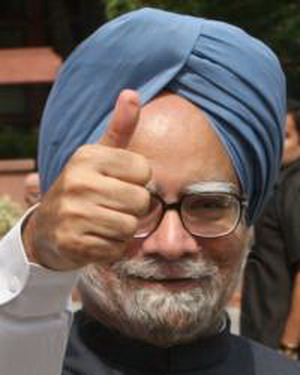
Manmohan Singh
Manmohan Singh : PM sees reforms benefiting poor

Bhubaneswar, Dec. 27: Prime Minister Manmohan Singh today said the economic reforms initiated by him almost two decades ago had reduced the number of poor, though much more was still needed to be done.

“There is no evidence that the new economic policies have had an adverse effect on the poor,” Singh said at the annual conference of the Indian Economic Association here today.

“The percentage of population below the poverty line has certainly not increased. In fact, it has continued to decline after the economic reforms, at least at the same rate as it did before,” he said.

Singh, however, admitted that the decline should have been faster. Reforms were introduced during Singh’s tenure as finance minister in Narasimha Rao’s Congress government in 1991-96.

“There is no doubt in my view that poverty remains a major challenge. Our poor are still too poor and we need to do much more to improve their standards of living,” Singh said, highlighting the need for rapid economic growth to create job opportunities at a rate faster than the expansion of labour force.

According to the Prime Minister, greater attention should be paid to education, healthcare and rural development, particularly the needs of the Scheduled Castes, Scheduled Tribes and minorities, to achieve the objective of inclusive growth as charted out in the Eleventh Plan.

An efficient use of scarce natural resources such as land and water, increasing agricultural productivity and systematic efforts to help small industries in mobilising resources for growth were also necessary for a sustained expansion.

On the impact of reforms, Singh said an average growth rate of 8.5 per cent had been achieved between 2004-05 and 2009-10. The momentum was interrupted by the global economic crisis in 2008, and growth slowed to 6.7 per cent in 2008-09. However, the economy was likely to achieve growth at a little over 7 per cent in 2009-10. Besides, there was no balance of payments crisis since 1991.

On climate change, the Prime Minister said the problem could be resolved if all the countries reached a mutually satisfactory solution.

Prime Minister Manmohan SinghPM sees reforms benefiting poor
Prime Minister Manmohan Singh

Pointing out that sustainable development was intimately linked with energy efficiency and energy security, he said it also posed complex problems of global equity in burden sharing.

“Economists have much to contribute to our understanding of complexities involved and finding constructive solutions,” he said.

Orissa chief minister Naveen Patnaik said about 5 per cent of the country’s poor were in Orissa, while there was a large population (38.66 per cent) of Scheduled Castes and Scheduled Tribes.

He said the state government had been trying to improve its fiscal health and plan performance and create an investor-friendly environment. “Our efforts have yielded some very positive results with the state achieving an annual average growth rate of 9.15 per cent during the Tenth Plan.” (News Courtesy By Telegraphindia.com)
Readmore »

No further action until consensus: Manmohan assures Buddhadeb

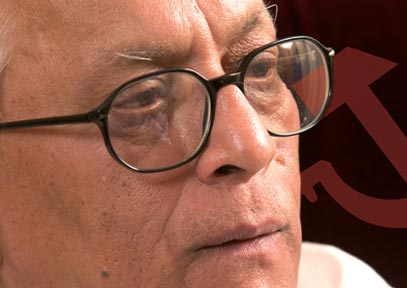
West Bengal Chief Minister Buddhadeb Bhattacharjee


No further action until consensus: Manmohan assures Buddhadeb

West Bengal Chief Minister Buddhadeb Bhattacharjee addressing the media in New Delhi on Sunday.

NEW DELHI: Prime Minister Manmohan Singh has assured West Bengal Chief Minister Buddhadeb Bhattacharjee that the Centre will not proceed on the Telangana issue until consensus is arrived at. Mr. Bhattacharjee told journalists here on Sunday that he called on Dr. Singh on Saturday seeking to know how the Centre intended solving the Telangana issue as it had a direct bearing on the hill areas and other parts of West Bengal.

It was learnt from the Prime Minister that the Centre was seriously trying to initiate a dialogue at the State and national levels.

Mr. Bhattacharjee pointed out that various parties had taken different stands and the parties in Andhra Pradesh were also divided on the Telangana issue.
Pandora’s box

He stressed his opposition to creation of smaller States, saying it was neither possible nor desirable in the present circumstances.

He warned that the setting up of a second States Reorganisation Commission would only open a Pandora’s box. “What for? The demand currently is for creating 28 States. If you set up the Commission, the number will only increase.”

The two leaders also discussed the issue of naxalites. Mr. Bhattacharjee said a national-level operation against them would start soon. The situation in Jharkhand was being assessed as a new government is to be formed there.

He said the naxal problem could not be solved through policing alone, and called upon Mamata Banerjee’s Trinamool Congress to attend meetings held by the district administration and participate in the process of restoring peace and harmony.

Mr. Bhattacharjee said the anti-naxal operations in West Bengal had yielded results with main roads coming under government control. “We are yet to enter the villages located in the forest. It is very difficult. They throw bombs and kill innocent people.”

Asked if he had raised the issue of Trinamool’s alleged links with naxalites with the Prime Minister, Mr. Bhattacharjee said: “I don’t need to do that. He knows everything.”

To another question, Mr. Bhattacharjee said his government was serious about arresting Maoist leader Kishanji, who was talking to hundreds of journalists every day and yet remained elusive. The government identified a mobile tower but locating him in that area was proving difficult.

The Chief Minister said he had read reports about the protest Kishanji lodged on the phone with Principal Environmental Secretary Madan Lal Meena against polluting mines. Mr. Bhattacharjee said he would talk to Mr. Meena.

The Prime Minister also assured the Chief Minister that he would look into the problems afflicting the Haldia Port, and at setting up industries at pitheads of mines and formulation of a separate jute policy to boost export.
New Governor

The State will have a new Governor by Republic Day to fill the vacancy caused by the expiry of tenure of Gopalkrishna Gandhi.

Dr. Singh conveyed the Centre’s intention to Mr. Bhattacharjee on Saturday.

Mr. Bhattacharjee declined to divulge specifics on the matter. He admitted that names were discussed. The appointment would be made before Republic Day.

He also refused to comment when asked if Union Minister Mamata Banerjee’s proposal of retired Justice Rajinder Sachar for the post was discussed with Dr. Singh. (News Courtesy by Hindu.com)

West Bengal Chief Minister Buddhadeb Bhattacharjee
Readmore »